Showing posts with label Sisters. Show all posts

Sunday, May 25, 2014

It aint easy being a woman, especially in Africa...


25 March 2014


The concept of being “born” is a crazy one; one moment you don’t exist, the next moment, boom, there you are.  The clock starts, experiences happen, memories form.  We have no control over by whom or how we are born, it just happens to us.  I didn’t choose to be born into a family with kind parents in a developed country, but I sure feel fortunate I was.  As we travel around Africa and I interact with my peers here, I can’t stop thinking how lucky I am.  At the same time, I feel kindred to these women; I could be her, she could be me. 

Life is harder for women; some may argue that, but I believe that is a fact.  As women, the world over, we subject our bodies to the risks of pregnancy and childbirth, we are more likely to be the victims of sexual and domestic violence, we are sexually objectified, we earn less money than our male counterparts, and even in developed countries, we must endure sexual oppression.  All of us women of the developed world can share stories of our experiences with gender-based harassment, abuse, discrimination and oppression, but our sufferings most likely pale in comparison to the sufferings of our “sisters” in the developing world.

Let me enlighten you with the facts about life as a woman in Zambia.  She starts off with fewer days on her clock than we do, with the projected life expectancy for a Zambian woman being 58 years (compared to 81 in the US).  She might consider herself lucky to even make it past the age of 5, since 89 out of 1,000 Zambian babies won’t make it that long (compared to 7 of 1000 US ones).  She will probably start bearing children at a young age since 125 of 100,000 live births are to women aged 15 to 24 (compared to 31/100,000 in the US).  She will have a lot of babies, on average, nearly six.  Not all of those babies will make it through pregnancy, as Zambian infant mortality is 56 of 1000 live births (versus 6 of 1000 in the US).  There are also fairly good odds that she may not survive pregnancy or childbirth either since 8% of women of reproductive age will die during childbirth (compared to 0.8% in Canada and 1.5% in the US).  Sometime during her life, she very well may be contract HIV, with prevalence in Zambia of 14%.

Zambian women might actually feel fortunate when they compare themselves to some of their neighbors, though.  The situation seems to be particularly poor in Chad and Sierra Leone.  Chad has the highest adolescent fertility rate at 152 of 100,00 births and the second worst maternal mortality at 980 per 100,000 childbirths, which translates into this staggering fact:  29% of women of reproductive age will die during childbirth. One out of three!  Sierra Leone has the highest maternal and infant mortality rates in the world at 1100 per 100,000 births and 117 per 1000, respectively.  A few other countries in Africa had some shocking statistics as well, like the 20% prevalence of HIV in women aged 15 to 24 in Swaziland.  Then there is the 39% female literacy rate in Mali (compared to 56% in their male counterparts).  Finally, there is also the fact that 44% of girls aged 7 to 14 are employed and working in Burkina Faso and Guinea. 
 
The many reasons I listed are essentially why I am here in Zambia right now.  Providing contraception and educating women about family planning saves lives of women and children.  That is a fact.  With an unmet need for family planning quoted at 27% in Zambia (compared to 7% in the US), there is still room for improvement.  That is why groups like PSI, the NGO with whom I am working, have helped to establish Family Planning programs in Zambia and similar countries.  It is not as simple as merely teaching the local providers about contraception and providing the birth control methods though.  There are many barriers to overcome here that we simply do not deal with in the developed world and many of these barriers are just inherent to being a woman in Africa.
 
The first barrier is education and socioeconomics.  The women that I have seen in the clinics here are not a privileged and educated bunch.  In 1998, it was estimated that 63% of Zambians were living below the poverty line, making less than ONE DOLLAR a day.  This number has surely improved since then, but I hope it illustrates the kind of poverty I am talking about here.  Many of the women that I have seen interviewed seem to have made it about halfway through school, maybe to grade 7.  One woman said she never went at all.

There are a whole slew of contraceptive myths we have encountered during our trip which, to me, also highlight the lack of education these women have:  “the implant can move from the arm to the heart and pierce it,” “IUDs cause cancer,” “if the man’s penis is very long, can it move the IUD out of the womb.”  Half of the work that I have been involved with here is focused on educating women, dispelling myths, increasing awareness, and even identifying women in the community that spread rumors against contraception. 

Transportation, or lack thereof, is another huge barrier.  Driving down the roads, we see hundreds of women on foot with babies strapped to their backs or fronts, maybe even simultaneously breastfeeding.  If they are lucky, they may have a bicycle for transportation, but it seems mostly men get the bikes.  Some rural areas may not have a clinic or hospital any closer than 15-km.  Although the majority of Zambians have mobile phones, the reception in these rural areas is unreliable.  All of these realities explain why only 42% of Zambian births are attended by skilled professionals.  This circles back to the maternal mortality again…

The women here do not have a lot of control over their lives.  The men largely dictate when and how many children they have.   I have heard a number of women say they don’t want any more children, but they must defer to their husbands.  The men get to have the final say about contraception and whether they can use it.  Many of the contraceptive counselors here sell the IUD to the patients by reminding them that it is a “secret method” that their husbands will not be able to tell they are using.  She can’t use the female condom for pregnancy and HIV prevention, because the man will think she is promiscuous and diseased instead of empowered.  In some groups, the women don’t even get to decide when they can wash or shave their genitals, as the husband must perform it.  If she were to wash or shave herself, it would lead him to believe she was unfaithful.  Many of the husbands even send the women to do the manual labor like farming or selling of produce, while they do the beer drinking.  They do it all while tending to a couple small children at the same time.


Domestic violence is clearly another major problem here based on the number of billboards and posters around the country making public service announcements.  Nearly every other woman who is interested in the contraceptive implant (in the arm) has asked, “If the man beats you and hurts your arm, can the implant move to the heart?”  Domestic violence is clearly all too common a worry on these women’s minds. 


During one of our clinic visits last week, the nurse asked the patient if she would mind letting us observe the insertion of her IUD.  She giggled a little at first, looking shy, but they said, “Yes, why not, they are my fellow sisters after all.”  When you have a rough day and feel like life can’t get worse, remember your sisters in Africa. 

(Statistics I listed came mainly from the World Health Organization but also the World Bank, most stats were from 2013)

Sunday, August 14, 2011

The Scenic Route from Eugene to Bend


10 August 2011

The Scenic Route from Eugene to Bend

The chickens were squawking when I woke up that morning.  The air was cool and crisp outside the cozy little house.  I threw on my running clothes and crossed the street to the trailhead.  After just a few steps into the woods, it was cool and quite dark with very little light getting through the dense pine trees.  Jade said this was an old growth coniferous forest.  It certainly felt prehistoric with the huge ferns shooting out of the ground and the giant trees.  The fragrance of pine needles and bark was soothing.

The run turned into more of a hike at times, as the path got pretty steep.  I cannot say that trail running is my forte these days given that there really aren’t any woods in Houston.  I did my best and walked the steep ascents.  I later learned that this path would actually climb over a thousand feet to a peak.  I wasn’t ready for a run like that until I’d at least had some coffee and breakfast.

We reluctantly said our goodbyes to Kirk and Jade.  They said we were more than welcome to stay with them again if our travels landed us in Eugene later that week.  Kirk said he’d see me when I moved to Oregon.  We laid out our map of Oregon in the morning sun on the roof of the car and Kirk helped us plan our route to Bend.

Jason and I made a stop off at a breakfast joint called Off the Waffle before we hit the road.  We ate our local and “mostly organic” waffles with some coffee in the sun.  The waffles were crispy and delicious.  On top of mine there was a fried egg, spinach, tomato, red onions, feta cheese, and garlic yogurt sauce.  

We followed a scenic road along the McKenzie River as we went from Eugene to Bend.  It was a gorgeous drive full of evergreen lined mountains, wide valleys, raging rivers, expansive farms, and colorful wild flowers.  I drove Jason crazy as I asked him to pull off the road when a photo-worthy scene pulled into view.  Had I been traveling alone, I would have been stopping every few miles to take pictures and made it into Bend a week later.

There was a white covered bridge over the McKenzie and we pulled into the shoulder by the McKenzie Hatchery to take pictures.  We ran across the old bridge, not as old as the ones you might see in New England but still pretty.  There was a man fishing with his dog under the bridge.  I picked some raspberries off of a bush.  I had pee before we got back in the car.  Note to self:  squatting in a raspberry bush is a prickly experience.  Jason was kind enough to capture it on film.


It was a steep, winding road to get over the mountains into Bend.  While we drove, Jason decided to name our little silver Ford Focus, Bettina.  He gave Bettina much positive reinforcement and encouragement as she chugged along through the switchbacks and vertical climbs.  I was impressed to see cyclists riding up the same roads that our car seemed to struggle with. 

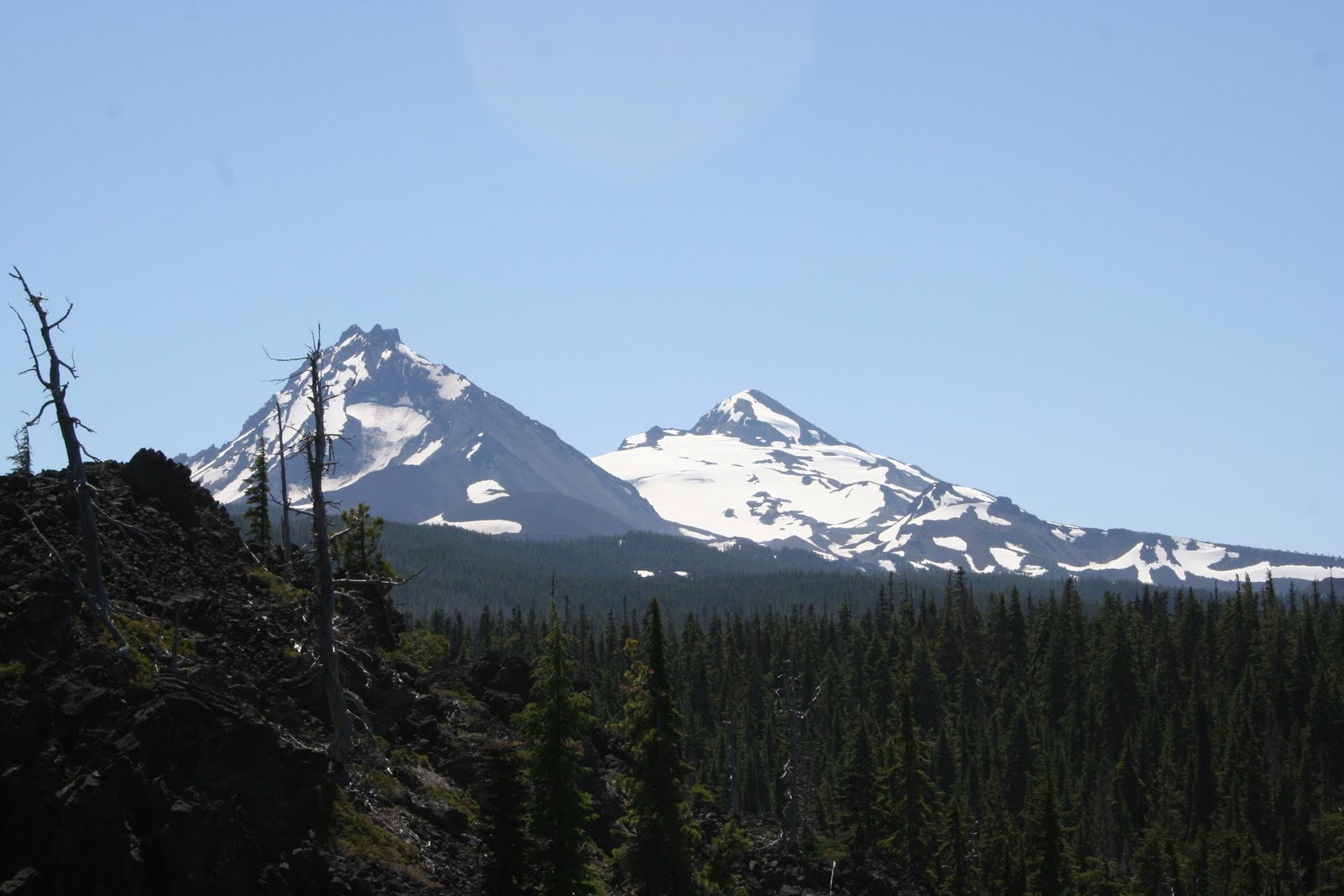
When we finally got to the top of the mountains, the tree lined opened and we were in a huge lava field.  Jade’s description was right; it looked like Mars.  We jumped out of the car and climbed up the sharp old lava rocks.  A fall on these stones would be treacherous so we took our time.  It reminded me of the volcano hike I’d done with my family in Guatemala, except this time there was no molten lava nearby.  Further down the road, we also stopped at the Dee Wright Observatory which offers great views of all of the surrounding snow capped mountains and the miles of lava fields.


Before long, we started our descent from the mountains.  The sun was blaring in a cerulean sky as we drove in to Sisters, the first large town we’d encountered in miles.  There were vast ranches in the valley of the mountains we’d just passed through with horses frolicking.  The historic downtown of Sisters looked like it could have been the scene of an old country-western film.  We pressed onto Bend.


It was lunchtime when we arrived in Bend so we made a stop for lunch as our first priority.  Bend has the most breweries per capita of any town in Oregon (and probably the US).   We chose to stop at the Bend Brewing Company, which is right on the river.  We sat outside in the midday sun and chatted with the friendly waitress who had recently moved there from West Virginia.  She moved here for the rock climbing.  I tried the brewery’s dry Irish Stout and then got the last glass of their sour beer, which was made with pomegranate and hibiscus.  It was one of the most interesting beers I’d had in a long time.  I could take a growler of that home with me.


After a stroll around the quaint downtown of Bend, we took the waitresses recommendation to visit Tumalo Falls, just outside the town.  It was about a twenty-minute drive to the falls and short hike up from the parking area to get a good view of the falls.  It was already about four o’clock in the afternoon at this point.  We wished we had more time to explore the area around Bend, but we wanted to find a campsite for the evening.  After making some phone calls and talking to a ranger, we discovered that virtually all of the campsites in Bend were reserved. 

With all the many miles of wilderness, I suggested to Jason that we just leave the car, hike into the woods with our gear, and find our own “illegal” campsite.  Jason is much more a practical rue-follower than I am, and he vetoed this idea.  Instead, we hopped in the car with plans to head towards Crater Lake and hope to find a place to camp at one of many of the sites that our map said would be on the way.

On our way out of Bend we drove through a beautiful park full of people running, cycling, lounging, walking, and swimming or tubing in the river.  I had never seen a town quite as athletic and outdoorsy as Bend.  There was a farmer’s market taking place that evening.  When I spotted it, I screamed, “Stop! Here! Turn!  Let’s go to the farmers market!”  Jason rolled his eyes, “You are ridiculous, Kate.”

I think he was happy about the stop, because we got some incredible food to take on the road.  We had both developed quite an addiction to Oregon berries, so we picked up a few more pints.  There was a fantastic bakery on site.  We bought a loaf of bread made with porter and carmelized onions.  I got a slice of the marionberry and rhubarb galette, and the friendly lady who worked there gave Jason a free garlic, parmesan baguette.  I grabbed some goat chevre from the dairy people.  I learned that we were lucky to have been in Bend that day, because this beautiful market just happened once a week.  It was such a pleasant, sunny evening in the park.  I could hear bongo drums in the distance. I wished there was more time!


About an hour south of Bend, we pulled off the highway near a town called, La Pine.  From the looks of the map, there should be about a half a dozen designated campsites in the national forest here.  The first campsite we found was a paved circular drive with some RV parking spots.  We pressed on.  The next camp area seemed more legitimate.  We had to drive down a dusty dirt road to get there.  There was a river running nearby.  There didn’t seem to be many other campers there.  The only other sign of life we saw was a pair of motorcycles. 

Jason and I were filling out the campsite form and were about to pay our $10 when a 1990s Honda came tearing down the road.  We watched as the blonde man inside drove donuts in the dusty road.  He stared us squarely in the eyes before speeding back down the road.  “Oh no, we are NOT staying here!”  Jason said.  “I do not want to be hacked up into little pieces by some serial killer while we sleep.” 

A few miles down the road we followed a sign for another campsite.  It was about a 10 minute drive through the woods down a desolate road until we arrived.  It seemed to be a popular site as there were quite a few other groups occupying the campsites.  There was a lake and a river in the vicinity.  It was not the primitive kind of camping experience I had envisioned we’d be doing in Oregon, but it would do.  After we scoped out the place for any would-be murderers, Jason gave the place his seal of approval and we unloaded our gear. 

I was excited to use my new tent for the first time.  We set it up behind a large pine tree just before the sun set.  It quickly got chilly, and I put on all of the warm clothes I had.  We weren’t even that hungry after all the farmer’s markets snacks we’d eaten on the drive from Bend, but Jason wanted to try out his camping cookware. 


While we waited for the water to boil, I walked around the campground.  Even though it was August, it felt like an autumn night.  The air was cool and dry and I could smell pine needles, leaves, and a campfire in the distance.  I stood at the still edge of the lake and watched a flickering fire reflect off the water.  If it weren’t for the bright, full moon, the evening stars would have been brilliantly visible in the clear night sky.  All of these sensations took me back to childhood memories of Girl Scout camping trips in the Appalachian Mountains of northern New Jersey when we’d sleep in cabins, make smores in a bonfire, and tell ghost stories all night.  It also made me miss of the wilderness New England where I’d hiked and camped with my good friend, Mike, before moving to Texas.


The water had just finished boiling when I returned to our campsite.  Jason poured it over our freeze-dried macaroni & cheese and we waited while it soaked.  It was soothing to be in the peace and quiet of the great outdoors.  After we ate, there wasn’t much else to do but retire to the tent, and frankly that was the only way to keep warm.  I read my book with my headlamp while Jason snored next to me.