Thursday, August 30, 2012

Southwestern Excursions


23-25 August 2012

Southwestern Excursions

From an airplane, New Mexico looks like another planet.  The brown and arid land is dotted with occasional bushes and vegetation.  The expansive flat land is interrupted occasionally by mountain ridges as far as the eye can see.  Albuquerque is like an oasis in the midst of it all. 

In this sleepy little airport, it took me less than five minutes to walk from my airplane to the front of the airport where I easily found the shuttle to my rental car.  The middle-aged driver eagerly lifted my suitcase on the bus, said hi, and asked me where I had gotten my interesting necklace from.  Once we all boarded the shuttle bus, the driver came over the loudspeaker and introduced himself as Bill.  He informed us that the ride to the rental car area would take about 3 minutes.  He went on to give us the statistics on Albuquerque including the weather forecast, how many miles of visibility we had today, the exact time of tonight’s sunset, and the population of the city.  When he lifted my suitcase off of the bus again, he said, “I really would have liked to talk to you more.”  Normally A comment like that would have seemed sleezy coming from a middle-aged married man, but he did it in such a genuine way as if to say, “You just seemed like an interesting person with whom I would like to have a conversation.”  I would come to find that this genuine and open sense of friendliness was common in New Mexico.

After a long day of work and traveling, I was in need some caffeine.  Right across from the University of New Mexico campus, I found a café called Satellite Coffee.  The shop and its patio out front was full of students, hipsters and aged-hippies; some were discussing their studies, others were smoking marijuana.  I asked an older couple to watch my laptop while I went to the bathroom.  The woman said that she would tackle anyone who tried to steal my computer. 

After completing a full day of interviews at the University of New Mexico, I set out to explore Albuquerque some more; if there was a possibility I might live here for 2 years, I’d better get a feel for it.  I changed into my running clothes after the interview was finished and set off to find a trail.  I drove east out of Albuquerque and headed towards the mountains; in about 20 minutes I arrived at the foothills.  There were miles of paved running/biking trails along the road.  At that higher elevation I could see the city below and dessert beyond.  The sky was bright with the afternoon sunlight and dotted with impressive clouds.  It took me about 30 minutes to drive about half of the perimeter of Albuquerque.  I finally parked my rental car near a park that runs along the Rio Grande river where there were many more miles of running and biking trails.  Being used to Houston humidity, it was wonderful to take a run in the cooler and drier weather.  My pace was faster than it had been in the Texas heat, but I did feel a little short of breath in the 5000 feet altitude of Albuquerque.


I had dinner plans with my friend, Nancy, that night.  On the way back to the hotel to shower, I took a quick drive through Old Town Albuquerque which is full with old adobe buildings painted in rich browns and reds. 

I met Nancy on Central Ave, which is also known as the old Route 66.  For miles, this road is full of restaurants, shops, bars, and other industry.  Most of the buildings have a retro or southwestern design and funky neon lights that remind me a little of the older part of Las Vegas. I drank an Albuquerque-brewed IPA at the bar in Nob Hill where I met Nancy and her brother and sister-in-law.  On the way to the gourmet taqueria where we ate dinner, they all kept running into people they knew, old friends from highschool and so on.  Albuquerque may be a city but it feels like a close community.

We ended our night at a club set inside one of the oldest buildings in Albuquerque called Casa Ascensia.  It has been a long time since I have gone out “clubbing.”  While I waited in the long line to get in, wearing jeans and a shirt, I felt grossly overdressed.  The barely-twenty-one year old club-goers around me were quite scantily clad even from my liberal perspective.  It seems that the new trend is spandex micro-mini skirts or high-waisted 1980’s style short-shorts, even for the obese girls.  Trendy clubs with cover-charges and dress-codes are not my scene, but I enjoyed catching up with Nancy, dancing to some 1990s throwback music, and watching the drunk kids go by. 

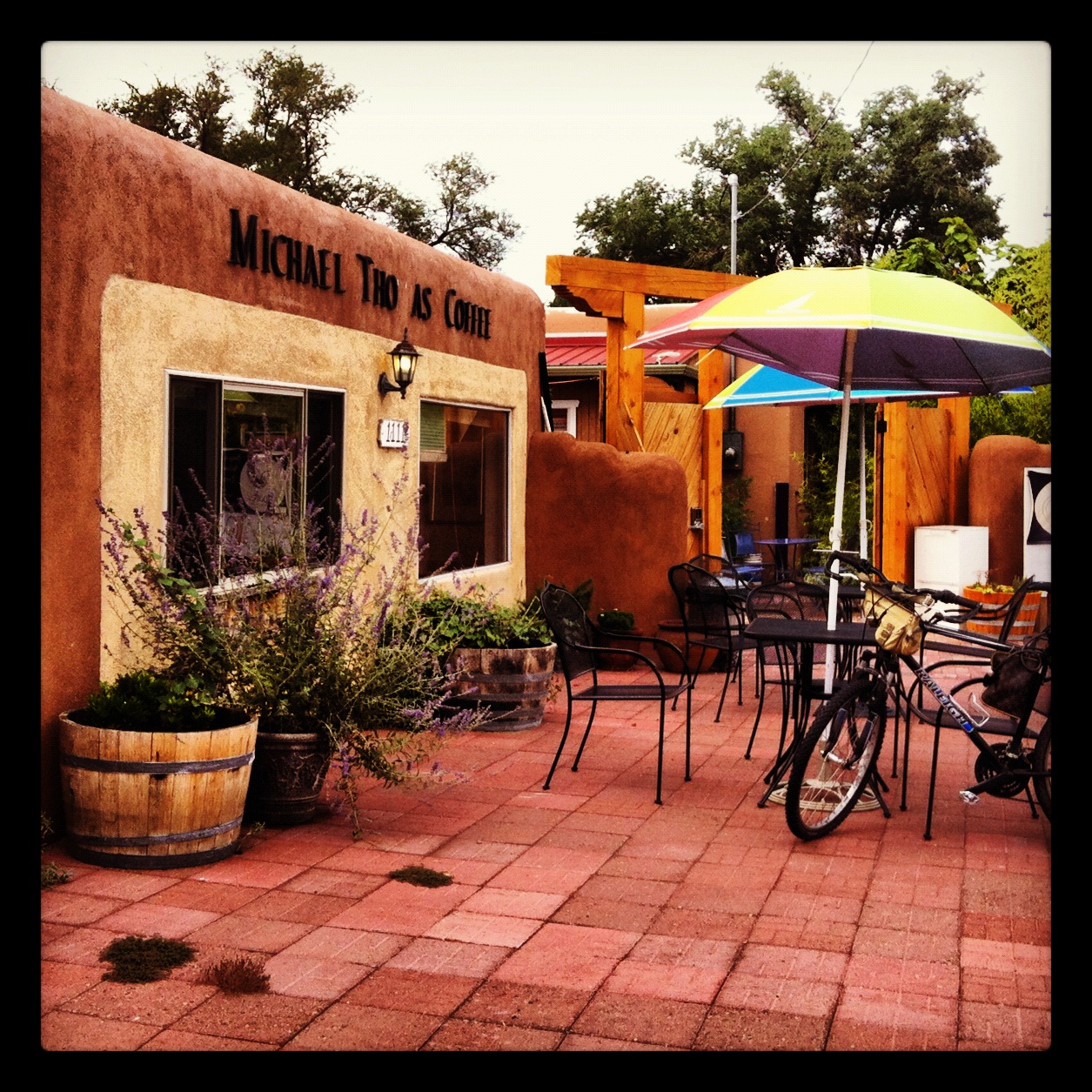
I considered catching up on sleep the next morning, but decided life was too short to sleep in and got up early to drive to Santa Fe.  I had always heard Sante Fe was a magical place and so I didn’t want to miss out on an opportunity to visit it.  Albuquerque was quiet and sleepy when I hit the road around 7:30am.  I could see about half a dozen hot-air balloons floating through the sky over the dessert.  After grabbing a coffee Michael Thomas Roaster, at a small café their roasts their own coffee beans, I jumped on the highway.

Santa Fe is a quick drive from Albuquerque; with a speed limit of 75 mph, one can arrive in Santa Fe in under one hour.  There were some stunning desert vistas along the way contrasted with bleak looking Native American reservation land.  It had been quite a few years since I had driven through the beautiful southwest.  Every time I do, I am taken by this feeling of openness, adventure and possibility when I see the long straight road stretching for miles ahead and surrounded by beautiful nature. 

When I arrived in Santa Fe around 9am, the town was still waking up.  Before the hoards of Saturday tourists arrived, I got to walk through the small but beautifully preserved adobe city as the sun light up the warmly-colored earth-toned buildings.  This year, Santa Fe is celebrating its 400 year anniversary which is almost hard to believe considering how well-kept the structures are. 

I had brunch at a restaurant called Pasqual’s Café, that I had read had one of the best New Mexican breakfasts in town.  As a single diner, I had to wait about 15 minutes to get a seat which was at a large community table in the middle of the small restaurant.  The man seated to my right was an older hippie, with his long white beard and red and green colored Hawaiian shirt, he looked a little like a desert Santa Claus.  The waiter approached him and said, “Hi Jim!  Are you going to have the usual?”

I turned to Jim and said, “So, I guess you’re a regular here?”  He told me that he has been coming to this café for 23 years.  I decided that I should probably order whatever he was having to eat.  It was called the Huevos Montelunos which had tortillas, eggs over easy, beans, red and green chilli sauce, green peas, and sautéed bananas.  It was delicious!

The couple seated on my left were in town for their son’s wedding later that day in Los Alamos.  The couple was from Los Angeles but hoping to retire in western Montana soon.  The man told me he was getting in touch with his artist side, that he had just written and published a book.  Turns out, his father was a famous actor in the 1950s, a heart-throb named Glenn Ford and so he had just written his biography. 

My flight out of Albuquerque was at 3pm so I didn't have much time left in Santa Fe.  I spent the last hour checking out a small artist fair and the jewelry and craft merchants located in the central square.  Most of the vendors were Native Americans selling turquoise jewelry. I couldn’t help but buy a variety of their wares.  They weren’t very open to my attempts to bargain a price, but I didn’t really care.  I can feel good about financially supporting the Native American efforts.  Before I knew it, the town clock struck 12 noon, signaling my departure back to Albuquerque.  If I jumped right in the car, I would have just enough time to make my flight to Denver.  If only I just had more time to explore....


Wednesday, February 29, 2012

Tents, Pit Toilets and Bovine Neighbors

14-18 February 2012

Tents, Pit Toilets and Bovine Neighbors

It was a long drive from the Dhakpo monastery to the campsite where we would spend the next five nights.  We slowly descended through the Kullu valley to a lower elevation, eventually ending up on road that circled the perimeter of a large reservoir.  After about 4 hours of driving, the caravan of cars stopped at a pedestrian only suspension bridge and we got out and walked the last mile to the campsite.

We could see our bright yellow tents from afar; they were set up in a neat row near the bank of the reservoir.  The campsite was located about 500 feet below the level of the road.  We all carried our heavy bags and suitcases down a narrow dusty trail, pausing to let a herd of cows pass us.  I was thankful to have a backpack I could carry easily on my back instead of a suitcase.  It was humorous to watch some of the others attempt to wheel their suitcases down the trail.

It was a beautiful afternoon, and we all settled into the campsite.  I was pleased that the weather at this lower elevation was at least 10 degrees higher.  Feeling quite sedentary, Karen and I decided to do some strength training like sprints, squats and push-ups on the edge of the water.  It was great to feel hot and sweaty instead of numb and shivering.

Throughout the course of our five night stay we worked four clinics.  The first was about a 45 minute drive away in a more remote section of the valley.  It was a beautiful site, surrounded by terraced fields and stone and thatched roof buildings.  The weather was gorgeous that day and we sat outside as we interviewed our patients.  There was a brief interruption of our clinic when a big local politician arrived for a rally.  There were firecrackers, horns and lots of fanfare.  The patients and our translator all momentarily left to listen to the speech.


I had quite a few interesting gynecological cases that day instead of predominantly primary care issues.  At the end of the day, we were even sent a male patient.  This was the first time I had seen a penis, in a medical setting, since medical school.  I quickly called Max, the ER resident, over for a consultation about the man's penile lesion-I was way out of my league there.

The second clinic was located 40 minutes away in an even tinier town than the first one.  Our examination tents were set up next to a small farm lot.  We ate lunch on the roof top of a box-like building.  I was really getting spoiled on the concept of an outdoor clinic--seeings patients while basking in the sunlight.  Why can't we do this at home?

The other two clinics were located at a school within walking distance of our campsite just near the foot bridge we had crossed on the first day.  The school site offered a great view of the reservoir and valley as it was set higher above the level of the water.  The school children were very curious about us the first day.  The giggled and posed for pictures, clearly we had distracted them from learning.  My gynecology exam table was placed in a dark smokey room the size of a closet.  The room was normally used as a kitchen and it had no electricity so we needed a camping headlamp to do exams.


On that day, our group provided a lunch for all of the school children and locals who visited the clinic.  A man had come down from one of the local Hindu temples to help prepare the meal and was wearing a special outfit.  I spent awhile in the "kitchen" which was just an abandoned building, watching the meal preparations.  When lunchtime finally arrived, the children sat on the ground, neatly lined up in rows.  They were served heaping mounds of rice, at least the amount of 4 servings.  They were also given lentils, a fried yogurt dish, and a salad.  Many of them had seconds.  It was probably one of the largest meals they had had in a long time.  It was also apparent why most of them had vitamin deficiencies and cavities from their unbalanced high glycemic index carbohydrate-laden diet.


The second day of our clinic at the school site, we had a small turnout of patients.  The villagers told us that there had been a suicide in one of the nearby towns.  A 23 year old man had hung himself and they'd found him that morning.  He had a one year old child.  They were preparing for his cremation.  When there was downtime in the afternoon, the children performed a song and dance routine for us.  Apparently it was a dance that is often done at Indian weddings.  In return, they asked us to perform for them.  Mandy, Karen, and Jess did some kind of aerobic dance routine for them to the tune of some '90's music playing on an iPhone.

In the afternoons and evenings, we got creative with different ways to entertain ourselves.  For some people, I think it was difficult to feel entertained without television or internet so a few resorted to drinking cheap vodka and rum in their tents or by the water.

During the afternoons, we might sit around on our camping stools, reading our respective books.  It was refreshing to finally be able to spend time reading a book for pleasure and not for study.  One afternoon, half a dozen of us visited the local Hindu temple where a man in some sporty sunglasses gave us a blessing.  The blessing consisted of some orange paint on our foreheads, sweet water to drink (or in our case, pretend to drink), flower petals, and sugary sweet rice puffs.  There was usually an afternoon cricket game being played in the large field by our tents.  The Americans were learning how to play the game from Ravi, the drivers, and the local kids.  Karen and I did yoga one afternoon by the water.  Another day, Jess and I went for a run along the main road.  In a matter of 2 weeks, I had already lost a lot of endurance and what would have normally been a simple 5 mile run turned into a challenging event.  The hill climbs didn't help either.


There were Hearts and other card game tournaments.  Some people went into the kitchen tent and helped the cooks prepare the night's meal.  One night we celebrated one of the medical student's, Shaneel's, birthday.  Ravi had brought birthday cake mix from the US and the cooks did a good job preparing the cake in their rudimentary propane-powered oven.  We drank beer and played music in our dinner tent and even had a little dance party.


There were periodic visitors to our campsite, both human and animal.  Besides the boys coming for a cricket game, some of the other villagers would also walk through the campsite, curiously looking at our tents.  Many times they were in the process of herding cattle.  Other times, the cows showed up alone; they didn't do much besides stand there and poop.  A few dogs took a liking to us, in fact one shaggy black dog ran along with Jess and me while we went out on our run.  He was a very good companion.  There was a little girl with a unibrow who we spotted many times at our site.  Sometimes she was collecting sticks, other times she was kicking cow piles around.  She always seem to show up out of nowhere, it was actually kind of creepy.  She seemed a little "off."  Max was even a bit frightened.

I enjoyed the camping experiences, overall, but was also glad to go back to some of the daily "luxuries" that we take for granted at home.  I had not had a proper shower in about six days.  Our version of a bath or shower was a large bucket of hot water in a "shower tent."  It was difficult to even get all of the soap off of the body, it was cold, and at the end, there was dirt and grass on my feet.  I had gotten used to squatting over a pit toilet, also known as a dirt hole, to go to the bathroom, but my knees were starting to feel sore.  There is something wonderful about a proper western toilet.  

Tuesday, February 28, 2012

Three nights at a Buddhist Monastery

11-13 February 2012

Three nights at a Buddhist Monastery

I was sure I had the flu when I woke up that morning in Manali.  My entire body was sore from shivering throughout the night and lying curled up in the fetal position.  I had tossed and turned, at times feeling like I was burning hot too-clearly I had had a fever.  The hotel room was still frightfully cold when I woke up, so cold, in fact, that I needed to psych myself up to just emerge from the bed covers.  I forced down some porridge in the cold dining room.  When one of the servers asked me how I was doing that morning, I responded that I was cold.  He agreed and said, "Too much cold, ma'am!"

It was a 45 minute drive from Manali to the site of our clinic that day.  We were headed for a government-funded Buddhist cultural school to do check-ups on the children there.  Our cars stopped at the bank of a river, just next to a narrow suspension bridge over a crevice at least 4 stories deep.  We were instructed to take our belongings and walk across the bridge and down hill a short distance to the school.

When we arrived, we found a long table set out in the sun.  The school teachers greeted us with warm, sweet chai and an assortment of biscuits.  We reveled in these treats while basking the the late morning sun.  Ravi took us on a short tour of the facilities.  Besides the classrooms and dormitories, there was also the beginnings of a clinic on site.  Ravi had been working closely with a local doctor to set up a general medicine clinic to service not only the Buddhist and Tibetan refugee population but also any local indigent patients.  It was a basic but clean clinic and Ravi promised that on future trips, we could work there.

After the tour everyone scattered to different stations.  I had Vik working with me for the day and together we did mostly a lot of well-child exams.  I have to give credit to Vik for doing the majority of the work, and doing it well, because half the time I felt sickly and exhausted.  Throughout the course of the day, we saw a lot of children with fungal skin infections resulting in hair loss, scabies bites, and awful dentition.  The children were quite shy but adorable.  They looked a lot more Asian than Indian, or at least what one normally thinks of as an Indian-looking person.

There were half a dozen people doing manual labor at the school while we worked at the clinic.  There were a few women carrying large rocks from one area to another and a couple of ragamuffin children running around or staring at us westerners.  I had noticed that one of the women appeared to be pregnant as I saw her transporting the large rocks on her shoulder and head.  Right as we got ready to close up the clinic for the day, I was sent one final patient; it was the pregnant worker.

I could tell that the female teachers at the school were quite worried about her.  They informed me that she had never seen a doctor before for her pregnancy and that everyday she was doing heavy labor.  "Please give her some good medicines!" they women pleaded.

According to the pregnant woman, she was about 27 weeks gestation.  Fortunately she had no complaints at all and had had 3 other normal healthy pregnancies.  I was the first and likely only OBGYN she would ever see.  I measured the height of her uterine fundus, easily felt the position of the fetus through her thin abdominal wall, and was just barely able to hear the fetal heart beat through my stethoscope.  I reassured her, and the teachers, that everything seemed to be fine.  We loaded her up with prenatal vitamins and recommended she see a local doctor.  The teachers kept asking me if it was okay for her to keep working. How do you tell a poor woman to cut out her source of income when she has 3 other children to feed?  The fact of the matter is that her body is used to this level of manual labor and thus it was unlikely to pose much of an ill effect on her.  Sometimes reassurance goes a lot further than any medical treatment.  I was glad I got to meet her.

At the day's end, we took another hour long drive to Dhakpo Monastery where we would be spending the next three nights.  It was a simple and fairly small monastery complex located in the Kullu valley surrounded by snow-capped mountains.  We found the place quite quiet when we arrived and we were told that this was due to the soon approaching Tibetan new year celebrations.  Some Tibetans celebrated for up to 15 days for the new year and so many of the monks, or lamas, had left for bigger monasteries or others were home for holiday.

Beth and I had a simple room consisting of two twin beds with thin foam mattresses and a shared bathroom without hot water.  After we dropped off our bags, some of us took a tour with one of the lamas.  He brought us into the main temple; it was colorful and ornate with large gold statues of Buddha and big photographs of the Dalai Lama and other important head lamas.  The temple was littered with many offerings to Buddha, mostly in the form of food items.

After our tour of the temple, I few of us lingered to wander around.  In the basement of the building, we found about thirty young monks chanting methodically.  A few of us peer back at us while we watched them.  They were clearly just as curious about us as we were about them.

It wasn't long before they all broke out of their chants and went from solemn Buddhist monks to mischievous little boys.  They all ran out of the room, fooling around, hitting each other with their books or cushions as they rushed out.  A few minutes later a bell sounded and a few of us followed the noise.  It was the dinner bell and slowly the monks all lined up with their own respective eating utensils.  Some had large colorful bowls, others had plates, and one even had a bucket.  Some older lamas served up dinner out of huge vats.  The amount of white rice they were given was quite impressive.  In addition, they also received lentils and spinach and potatoes.  There wasn't much protein in this diet.

The following day, our clinic was held at a Buddhist nunnery.  The girls were all shy and demure and with their shaved heads, it was hard to even distinguish some of them from boys.  The site was ridden with puppies and kittens, between that and the young nuns, it was like cute-ness overload.  But these nuns  were not as innocent as one would think.  When we were preparing to leave the clinic for the evening, one of our cars starting blaring loud 1990s music, like the Macarena.  A few of the nuns broke into dance which was, at times, quite seductive.  The others laughed and cheered them on.  A few of the medical students in our group joined in on the fun.

We had our next clinic at the Dhakpo monastery where we saw all of the young lamas and a few of the local villagers.  It was a very cold clinic located in the damp ground floor of the temple with no electricity due to heavy rains.   We had to wear hats and all of our layers to be comfortable; it didn't make my flu-like illness any better, especially now that the diarrhea had started.  I knew a GI bug was inevitable in India!  The cold weather seemed to keep a lot of locals away and we heard they got 2 feet of snow in Manali.  While there was downtime at the clinic, we huddled around the furnace, read books, and listened to an impromptu drumming and singing session by some of our drivers.

One afternoon, the drivers took us for an outing in the town of Kullu, located, of course, in the Kullu valley of Himachal Pradesh.  Kullu valley is often called the Valley of the Gods as it is home to 360 different Hindu temple gods.  Kullu valley was largely unknown to the western world until it was discovered by traveling hippies in the 1960s.  They were attracted to the region not only for its mountainous splendor, but also for the plentiful cannibas that grew on hillsides.  The town of Kullu is not a very exciting or classically picturesque town, but there was still much to observe with its many tiny box-like shops, street food vendors, and grungy alleys.  We walked through a produce market where brightly colored fruits and vegetables were sold out of carts.  The vendors were happy to pose for pictures too and laughed when I showed them the end result.  A visit to the butchery market was fascinating and slightly disgusting.  Half a dozen slaughtered goats hung on racks, some of them still dripping blood.  Their decapitated heads were available for sale, as were their innards.  There was also a nice selection of plump chickens and their feet too.  But of course, there was no beef to be found!

Ravi took us all to a confectioner shop where we tried a bunch of Indian sweets.  The Indians don't mess around with their sugar, these desserts were sweet enough to actually rot your teeth on the spot.  When we looked for our drivers, we found them not at the designated meeting spot but standing outside an open air liquor store where they were watching a cricket game on TV.  India was playing against Australia and the game was almost over.  Most of us had no idea what was happening with the game, but it was fun just to watch the crowd of men slowly accumulate, pouring into the street to watch the end of the big match.  They all had a big cheer when India won the game and then quickly went on their ways.